CPQ for Facility Maintenance: Multi-Site Contracts & Pricing
CPQ in Facility Maintenance: Managing Multi-Site Contracts and Dynamic Pricing
The Smarter Way to Configure, Price, and Quote Facility Services
TL;DR
Facility maintenance companies managing multi-site contracts face complex pricing challenges that traditional quoting methods can’t handle. Modern CPQ systems like Mobileforce.ai solve this by enabling location-specific pricing, dynamic service bundling, and mobile field quoting. Companies implementing proper CPQ solutions see 60-80% faster quote generation and improved pricing accuracy. With the facility management market growing at 8.2% CAGR to reach $2.28 trillion by 2032, investing in specialized CPQ capabilities is becoming essential for competitive success.
Key Insights
Understanding how CPQ transforms facility maintenance operations requires examining specific pain points and solutions that drive measurable business outcomes:
- Multi-location pricing complexity affects 89% of facility maintenance providers managing more than 25 sites, according to industry research. Each location requires unique pricing adjustments for labor rates, travel costs, equipment variations, and regulatory compliance requirements.
- Field service quote generation represents the largest untapped revenue opportunity in facility maintenance, with technicians identifying additional service needs in 40% of routine maintenance visits. Companies with mobile CPQ capabilities capture 25% more revenue per site visit compared to those requiring separate sales cycles.
- Contract lifecycle management across multiple sites creates administrative overhead that consumes 15-20% of operational resources when handled manually. Automated CPQ systems reduce this overhead by 70% while improving pricing consistency and contract renewal rates.
- Integration with existing systems determines CPQ success rates, with 85% of successful implementations requiring seamless connectivity to field service management platforms and customer relationship management databases.
- Dynamic pricing models, including usage-based components and performance incentives, are becoming standard requirements, with 60% of large facility maintenance contracts now incorporating variable pricing elements that traditional spreadsheet-based quoting cannot effectively manage.
Picture this: Your building services company just landed a massive contract to maintain 150 retail locations across 12 states. Each site has different HVAC systems, varying local labor costs, and unique service level agreements. Your sales team is drowning in spreadsheets, trying to calculate site-specific pricing while your operations team worries about managing service delivery across such a vast footprint.
This scenario plays out daily across the facility maintenance industry, where companies manage increasingly complex multi-site portfolios worth billions. According to Mordor Intelligence, the North American facility management market reached substantial heights in 2024, with commercial estates alone commanding 40.23% of market share. Meanwhile, McKinsey research indicates that AI implementation in asset-heavy sectors can reduce costs by 10-20%. The challenge? Traditional quoting methods simply can’t handle the complexity of modern facility maintenance contracts.
Ready to transform your multi-site quoting process? Schedule a demo with Mobileforce.ai to see how our no-code CPQ platform handles complex facility maintenance scenarios.
Why Facility Maintenance Demands Specialized CPQ Solutions
The facility maintenance industry presents unique challenges that standard CPQ systems struggle to address. Unlike simple product sales, facility maintenance involves complex service bundles, variable pricing models, and intricate contract structures that span multiple locations.
Multi-Site Contract Complexity Creates Pricing Nightmares
Managing contracts across dozens or hundreds of locations isn’t just about scaling up—it’s about handling fundamental differences between sites. A single facility service contract might cover 100 retail stores, but each location brings its own variables: different equipment ages, regional labor costs, local building codes, and access constraints.
Consider a national restaurant chain’s maintenance contract. The Manhattan location requires premium pricing due to union labor rates and restricted delivery windows. Meanwhile, the rural Texas location operates with lower base costs but faces higher travel charges for emergency service calls. Each site’s unique attributes must be captured and reflected in pricing algorithms, creating exponential complexity as portfolio size grows.
Property maintenance pricing must account for geographic variations, local contractor availability, equipment manufacturer specifications, and seasonal demand fluctuations. Multi-location service contracts require dynamic pricing rules that can automatically adjust for these variables while maintaining profitability across the entire portfolio.
ABM Industries, one of the largest facility service providers, secured over $1 billion in new contracts during 2024 as clients increasingly sought integrated offerings that could manage this complexity while maintaining accountability across all locations.
Looking to simplify your multi-site contract complexity? Discover how Mobileforce.ai transforms complicated pricing scenarios into streamlined, automated workflows.
Dynamic Pricing Models Require Flexible Systems
Facility maintenance pricing goes far beyond simple hourly rates. Modern maintenance service contracts blend base preventive maintenance fees with usage-based components, emergency service premiums, and outcome-based incentives. A typical building maintenance agreement might include:
- Fixed monthly preventive maintenance fees per location
- Variable parts costs based on actual consumption and equipment utilization
- Emergency service calls with overtime rates and weekend premiums
- Performance bonuses tied to uptime metrics and tenant satisfaction scores
- Escalation clauses for multi-year agreements and cost-of-living adjustments
These dynamic pricing elements must integrate seamlessly allowing sales teams to model different scenarios while ensuring pricing remains profitable across the contract lifecycle. Fortune Business Insights reports the global facility management market will reach $2.28 trillion by 2032, with much of this growth driven by sophisticated service models that require advanced pricing capabilities.
Outcome-based pricing models are becoming increasingly common in facility management software implementations. Performance-based contracts that tie provider compensation to measurable results like energy savings, uptime percentages, and maintenance cost reductions require sophisticated calculation engines that can process multiple variables while maintaining transparency.
Field Service Integration Becomes Critical
Unlike traditional sales scenarios, facility maintenance often requires on-site quoting capabilities. When a technician discovers additional maintenance needs during a routine service call, they need immediate access to pricing tools and inventory availability. This field-based quoting presents unique challenges for building service contractors:
- Limited or unreliable internet connectivity at remote facilities
- Real-time access to current pricing and parts inventory systems
- Integration with work order management and scheduling software
- Approval workflows for unexpected additional services and emergency repairs
Mobile CPQ solutions that function in offline environments become essential for capturing revenue opportunities that would otherwise require separate sales cycles. Field service management integration ensures that technicians can generate accurate quotes while maintaining visibility into scheduling constraints and resource availability.
Companies that can enable field-based quoting gain significant competitive advantages, capturing additional revenue opportunities that would otherwise require separate sales cycles. Digital transformation experts emphasize that 70% of facility managers have elevated digital transformation to a core strategic position, recognizing mobile capabilities as essential for competitive success.
Building maintenance software that supports offline functionality allows technicians to continue working even when cellular coverage is poor or WiFi networks are unreliable. This capability becomes particularly important for facilities located in remote areas or buildings with dense construction that interferes with wireless signals.
Ready to empower your field teams with cutting-edge mobile quoting? See how Mobileforce.ai’s offline-capable platform transforms field service efficiency.
Core CPQ Capabilities for Multi-Site Success
Effective facility maintenance CPQ systems must go beyond basic product configuration to handle the industry’s unique complexities. The most successful implementations focus on several key capabilities that address real-world challenges.
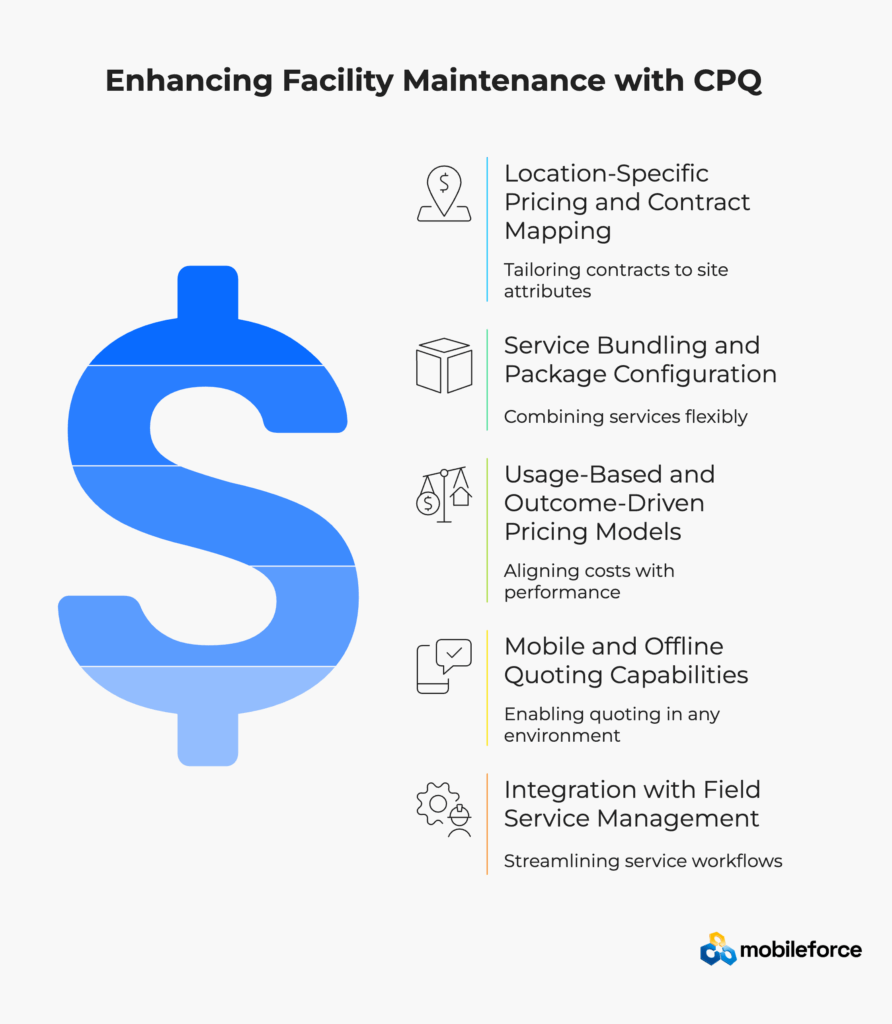
Location-Specific Pricing and Contract Mapping
Modern CPQ platforms must intelligently map service contracts to multiple locations while capturing site-specific attributes that affect pricing. This includes geographical factors like regional labor rates, logistical considerations such as parts delivery costs, and operational elements like equipment density and facility complexity.
Mobileforce.ai’s platform supports multi-tiered pricing, approvals, and distribution structures that can automatically adjust based on location attributes. For example, a maintenance contract might apply volume discounts for companies with over 50 locations while adding surcharges for remote sites requiring extended travel time.
Facility management pricing software needs to accommodate complex scenarios where individual sites within a portfolio have different service requirements, equipment specifications, and performance standards. Location-based pricing rules enable automatic adjustments for factors such as local prevailing wage rates, equipment manufacturer requirements, and regional regulatory compliance costs.
Service Bundling and Package Configuration
Facility maintenance providers increasingly offer comprehensive service packages that combine multiple elements. A typical bundle might include:
- Preventive maintenance schedules
- Emergency repair coverage
- Parts replacement programs
- Remote monitoring services
- Compliance reporting
The CPQ system must allow flexible bundling configurations where optional components can be added or removed based on site-specific needs. Some locations might require enhanced security protocols, while others need specialized environmental controls.
Transform your service bundling complexity into competitive advantage. Discover how Mobileforce.ai handles sophisticated package configurations with our no-code approach.
Usage-Based and Outcome-Driven Pricing Models
The facility management industry is evolving toward more sophisticated pricing models that align provider incentives with client outcomes. According to Grand View Research, outsourced facility management grew to 61.5% of global revenue in 2024, with much of this growth driven by performance-based contracts. Research from Gordian indicates that organizations are increasingly prioritizing outcome-based metrics and energy efficiency in their facility management strategies.
Modern CPQ systems must support various pricing models including:
- Consumption-based pricing: Charges based on actual usage of consumables, parts, or service hours
- Performance incentives: Bonuses tied to uptime, response times, or customer satisfaction metrics
- Risk-sharing models: Shared savings arrangements where providers benefit from efficiency improvements
- Hybrid approaches: Combinations of fixed base fees with variable components
These models require sophisticated calculation engines that can process multiple variables while maintaining transparency for both parties.
Mobile and Offline Quoting Capabilities
Field service requirements demand CPQ systems that function effectively in challenging environments. Technicians often work in areas with poor connectivity, basement mechanical rooms, or remote facilities where internet access is unreliable or completely unavailable.
Mobileforce.ai addresses this challenge with offline quoting capabilities, enabling field teams to provide quotes and proposals and update CRM systems anywhere, anytime, even offline. This capability becomes crucial when technicians identify additional maintenance needs during routine visits—capturing these opportunities in real-time rather than requiring follow-up sales calls significantly improves conversion rates.
Mobile facility management software that supports offline functionality ensures that service technicians can continue to generate quotes, access customer information, and update work orders regardless of connectivity issues. This is particularly important for building maintenance providers who work in remote locations or facilities with poor cellular coverage.
Integration with Field Service Management
Successful facility maintenance CPQ implementations require seamless integration with field service management (FSM) systems. This integration enables several critical workflows:
- Work order to quote conversion: Automatically generating quotes for additional services identified during maintenance visits
- Parts availability checking: Real-time inventory verification before committing to pricing
- Scheduling integration: Ensuring quoted services can be delivered within promised timeframes
- Performance tracking: Monitoring actual service delivery against quoted commitments
Implementation Best Practices for Multi-Site Success
Implementing CPQ for facility maintenance requires careful planning and execution. The most successful deployments follow proven methodologies that address both technical requirements and organizational change management.
Discovery and Site Profiling Strategy
Successful implementations begin with comprehensive discovery across the entire site portfolio. This involves mapping not just basic location information but understanding the operational characteristics that drive pricing variations in facility service contracts.
Key profiling elements for multi-location facility management include:
- Asset inventories: Equipment types, ages, manufacturer specifications, and maintenance histories
- Service level requirements: Response times, coverage hours, performance standards, and uptime targets
- Geographical factors: Labor markets, travel distances, and local regulations
- Operational constraints: Access restrictions, security requirements, scheduling limitations, and tenant considerations
This profiling phase often reveals opportunities for standardization that can simplify both pricing and service delivery.
Contract Template Development
Building flexible contract templates represents one of the most critical implementation phases. Templates must balance standardization with customization, providing consistent frameworks while accommodating legitimate site-specific variations.
Effective templates include:
- Base service definitions with clear scope boundaries and deliverable specifications
- Optional service modules that can be added based on site-specific requirements
- Pricing rules that automatically adjust for location-specific factors and market conditions
- Performance metrics and reporting requirements tied to service level agreements
- Amendment processes for adding or removing sites and modifying service scopes
Automated Pricing Rules and Logic
Moving pricing logic from spreadsheets into automated rules engines dramatically improves both accuracy and efficiency. Well-designed pricing automation can handle complex facility management scenarios like:
- Volume discounts based on total site counts across all contracts and service agreements
- Regional surcharges that vary by geography, local labor rates, and service type complexity
- Equipment age adjustments that reflect increased maintenance requirements and parts availability
- Seasonal variations for services like landscaping, snow removal, and HVAC maintenance schedules
Building maintenance pricing rules should be transparent and auditable while handling the majority of scenarios automatically. Exception handling processes must address unusual situations without undermining the automation benefits that drive operational efficiency.
Field Team Training and Adoption
CPQ implementations often fail due to inadequate attention to user adoption, particularly among field teams who may be skeptical of new technology. Successful rollouts include:
- Hands-on training using realistic scenarios from the company’s actual portfolio
- Mobile device optimization ensuring the system works effectively on tablets and smartphones used in the field
- Process documentation that clearly explains when and how to use mobile quoting capabilities
- Success metrics that demonstrate value to both field teams and management
Performance Monitoring and Optimization
Implementing CPQ is not a one-time project but an ongoing optimization process. Companies should establish monitoring frameworks that track:
- Quote generation speed: Time from request to completed quote across different complexity levels
- Pricing accuracy: Variance between quoted and actual service costs
- Win rates: Conversion performance across different site types and service categories
- Revenue per site: Trends in average contract values and add-on services
Regular analysis of these metrics enables continuous refinement of pricing rules, service packages, and sales processes.
Hypothetical Case Study: Multi-Site Retail Chain Transformation
To illustrate these concepts in practice, we present a hypothetical scenario based on common industry challenges and typical outcomes achieved by facility maintenance companies implementing comprehensive CPQ solutions.
The Challenge: Global Retail Services
Global Retail Services faced mounting pressure from clients demanding faster quotes and more transparent pricing across their 300+ location portfolio.
The Solution
Global Retail Services implemented Mobileforce.ai’s CPQ platform with specific focus on multi-site facility maintenance requirements. The implementation included:
Contract Template Standardization: Created flexible templates covering base maintenance, emergency services, and optional add-ons like deep cleaning and equipment upgrades.
Location-Based Pricing Rules: Implemented automated adjustments for regional labor costs, site accessibility, and equipment complexity.
Mobile Field Quoting: Equipped technicians with tablets capable of generating quotes on-site, even in locations with poor connectivity.
Integration with Existing Systems: Connected CPQ with their field service management platform and accounting systems for seamless workflow.
The Results
Six months after implementation, Global Retail Services achieved significant improvements:
- Quote generation time: Reduced from 3-5 days to 2-4 hours for multi-site requests
- Pricing accuracy: 90% reduction in pricing disputes and contract amendments
- Field revenue capture: 25% increase in additional service sales through on-site quoting
- Client satisfaction: The restaurant chain renewed their contract and expanded to 200 locations
Strategic Recommendations for Facility Maintenance Leaders
Based on industry trends and implementation experiences, facility maintenance companies should consider several strategic initiatives to maximize their competitive positioning.
Embrace Integrated Service Models
The facility management industry continues consolidating toward integrated service providers who can manage multiple functions under single contracts. Companies should position their CPQ systems to support bundled offerings that combine hard services with soft services.
Invest in Predictive Capabilities
The convergence of IoT sensors, predictive analytics, and CPQ systems creates opportunities for outcome-based pricing models. Companies that can quote maintenance services based on predicted equipment performance will differentiate themselves in competitive markets.
Scale Through Standardization
While customization remains important, successful multi-site operations require underlying standardization. CPQ systems should enable this balance by providing flexible frameworks that accommodate site-specific variations while maintaining operational efficiency.
Prepare for Market Consolidation
Industry consolidation creates both opportunities and challenges for facility maintenance providers. Companies with sophisticated CPQ capabilities will be better positioned to acquire and integrate smaller competitors while maintaining pricing discipline across expanded portfolios.
The Future of CPQ in Facility Maintenance
The facility maintenance industry stands at an inflection point where traditional service models give way to technology-enabled, outcome-driven approaches. Companies that invest now in sophisticated CPQ capabilities will be best positioned to capture this growth while maintaining profitability in an increasingly competitive market.